Build the Crime Before You Write the Novel.
Put an AI crime-fiction expert at your side to help engineer the crime, suspects, motives, clues, red herrings, timeline, twists and chapter roadmap before you write Chapter One.
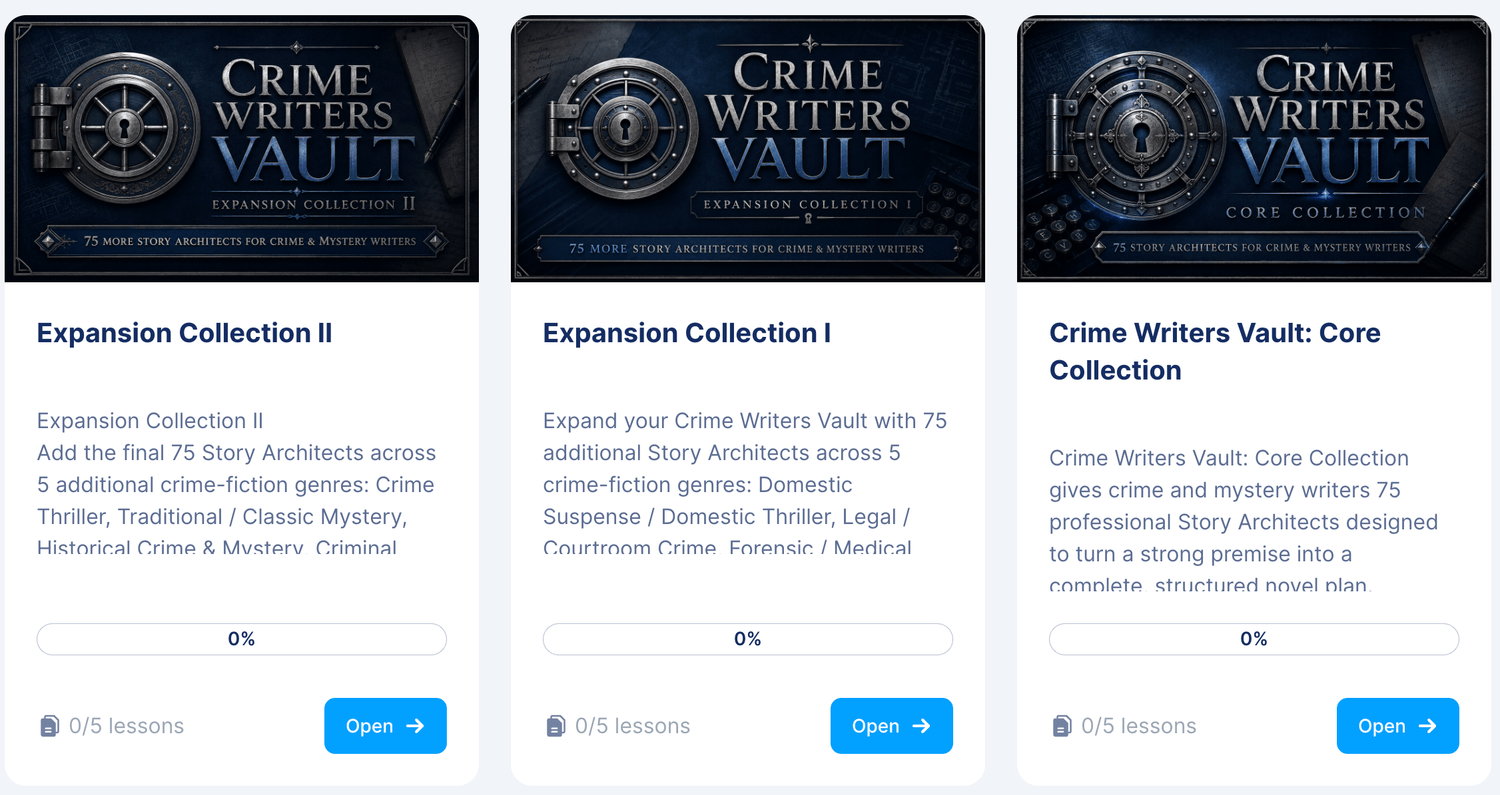
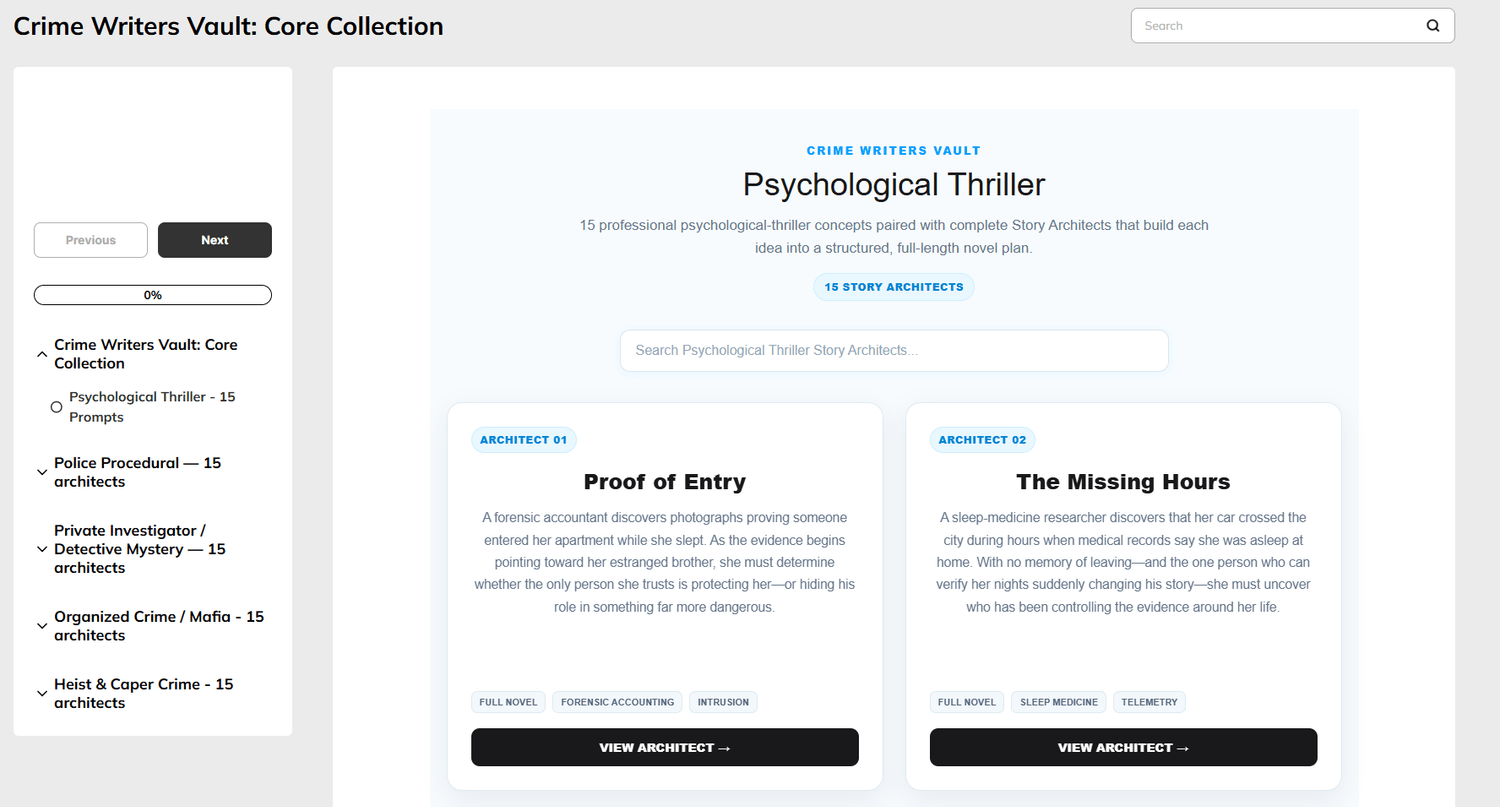
Crime Writers Vault gives you 75 complete Story Architects across 5 crime-fiction genres. Choose the story you want to write, use its Story Architect with ChatGPT, Claude or Gemini, and build the case from the hidden truth all the way to the final chapter.
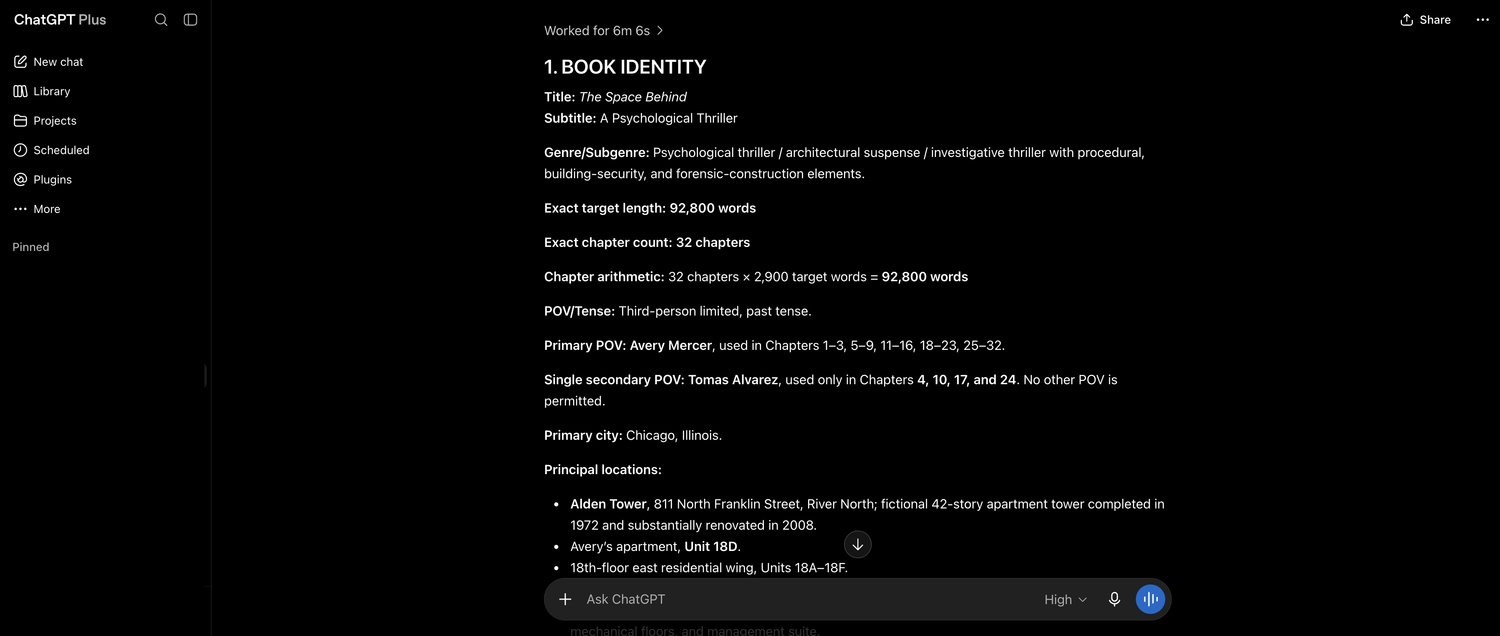
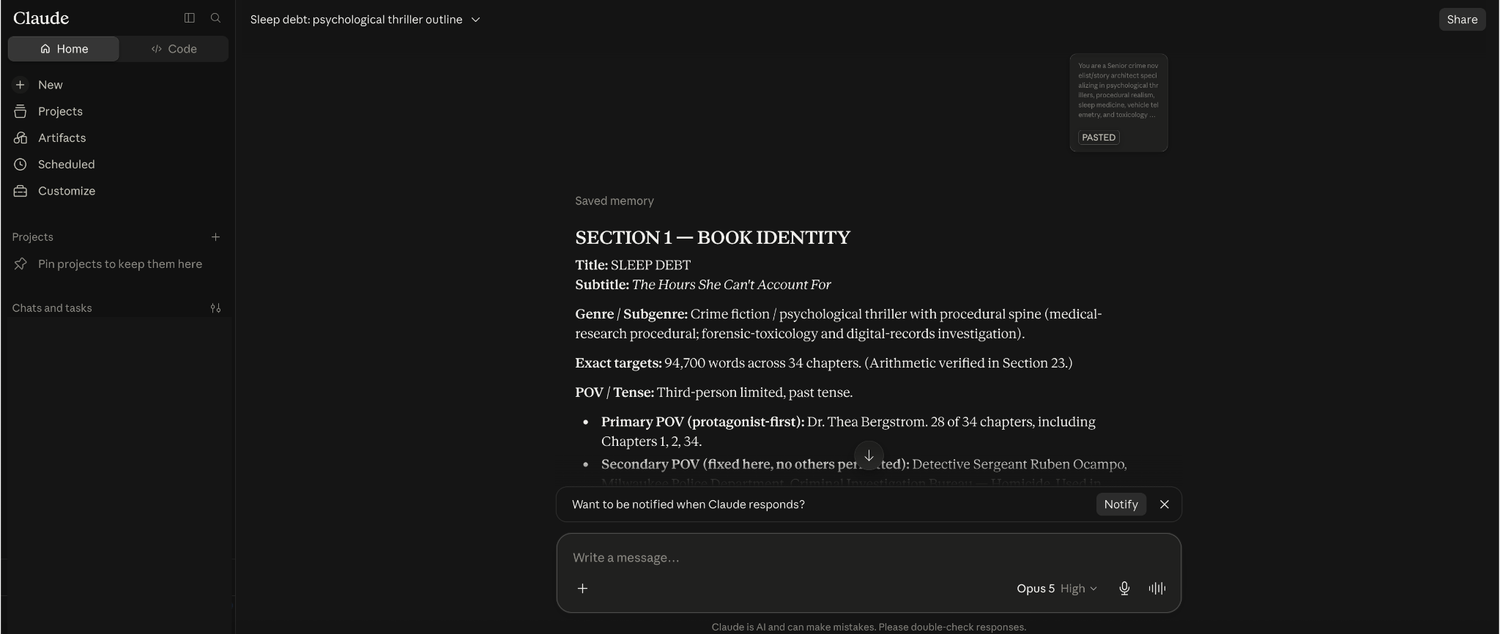
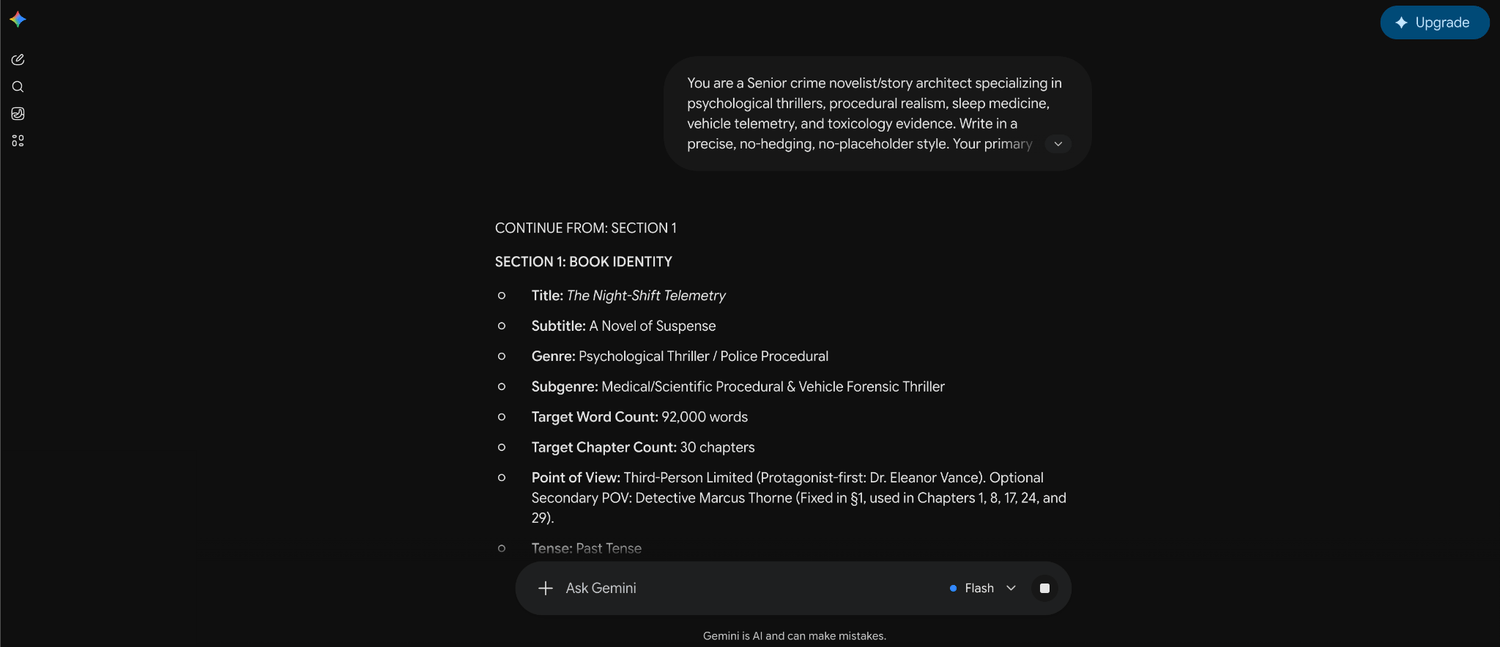
Watch a Story Architect Build a Psychological Thriller From the Ground Up
See one complete example go from a single story concept to the hidden crime, suspects, evidence, clue architecture, character knowledge, final solution and chapter-by-chapter roadmap.
Unlock all 75 Story Architects for $27.
5 genres • immediate download • works with ChatGPT, Claude & Gemini
Unlock Crime Writers Vault — $27 Download immediately after purchaseOne payment. No subscription required.
See the Story Architects. Then See What They Build.
There Is a Moment in Almost Every Crime Novel When the Story Starts Asking Questions the Outline Cannot Answer.
Maybe it happens in Chapter Six. Maybe Chapter Twelve. Maybe you've already written 40,000 words before you see it.
But eventually, crime fiction demands an answer to something you didn't completely work out before you started.
Your detective discovers a piece of evidence.
Good scene.
Except now you realize the evidence should have been discovered three days earlier.
Or your killer takes an action that creates a terrific twist... except there is no believable reason the killer would risk doing it.
Or the perfect suspect couldn't actually have reached the crime scene in time.
Or the clue that solves the case exists only because the plot needs it to exist.
And suddenly you're no longer writing the story. You're repairing it.
One repair creates another repair... and the manuscript that was supposed to move forward keeps dragging you backward.
Crime fiction is unforgiving because almost everything is connected: motive, means, opportunity, evidence, knowledge, timing, behavior, investigation and revelation.
That's why a crime novel can have great characters, sharp dialogue and a killer premise... and still collapse when the reader starts asking, "Wait. Why would that happen?"
And now AI has added a strange new version of the same problem.
AI Makes It Easier Than Ever to Create an Outline That Looks Finished.
Open ChatGPT, Claude or Gemini and ask for a murder mystery.
Seconds later, the screen fills with names, motives, clues, suspects, twists and chapters.
But a long answer is not the same thing as a fully engineered case.
The AI may give you a clue without asking whether the protagonist should have discovered it earlier.
It may create an intruder without explaining exactly how later break-ins remain possible after the locks are changed.
It may give the antagonist knowledge without establishing how the antagonist learned it.
It may create a dramatic final confrontation without explaining why the police, security or other obvious safeguards couldn't prevent it.
None of this means the AI is useless.
It means you gave it an assignment that was too small.
Crime Writers Vault is built around a much bigger one:
Build the truth first. Then build every lie, clue, suspicion, investigation beat and chapter around that truth.
That's the job of a Story Architect.
Choose a story concept, use its Story Architect with your preferred AI, and put a crime-fiction planning system to work beside you.
Unlock the Vault — $27 75 Story Architects • immediate downloadWhat If the AI Didn't Just Give You Ideas... But Had to Defend the Logic of the Story It Built?
That's the difference.
A Story Architect doesn't merely ask the AI to invent a killer, sprinkle in clues and produce thirty chapter summaries.
It gives the model a structured crime-fiction assignment and makes the pieces answer to one another.
If the killer entered the apartment, how?
If the protagonist could have discovered the truth earlier, why didn't she?
If a suspect lies, what true fact makes the lie believable?
If evidence appears in Chapter Twenty, where did it come from, who handled it and why wasn't it available in Chapter Ten?
If the climax puts the protagonist in danger, why can't the obvious authorities solve the problem first?
That's the kind of work that turns a pile of creative ideas into a case you can actually write.
What Does a Story Architect Actually Build?
A complete planning package designed to move from premise to solved case to chapter-by-chapter execution.
Book Identity & Commercial Foundation
The novel's core identity, premise, story question, emotional question, setting, structure and commercial direction.
Protagonist & Character Architecture
The lead character, relationships, weaknesses, secrets, pressures, supporting cast and the conflicts connecting them.
The Hidden Truth
What actually happened before the reader knows it: perpetrator, motive, method, means, opportunity and the real sequence of events.
Suspect Architecture
Multiple viable suspects with believable motive, opportunity, suspicious behavior, secrets and reasons to draw the investigation.
Clue Architecture
Clues designed with origin, placement, interpretation, discovery, significance and payoff in mind.
Red-Herring Architecture
Misdirection rooted in real facts, believable secrets and honest alternative interpretations instead of arbitrary deception.
Master Crime Timeline
A sequence that forces access, travel, opportunity, evidence and character behavior to work on the same clock.
Character Knowledge Tracking
Who knows what, when they learn it, what they believe, what they misunderstand and what information they are still missing.
Investigation Progression
A cause-and-effect investigative path where discoveries create the next questions instead of appearing because the outline needs them.
Escalation, Reversals & Revelations
Complications and turns that grow from what has already happened and change the reader's understanding of the case.
Final Confrontation & Complete Solution
A climax that follows from the investigation and a solution that accounts for motive, evidence, behavior and previously planted facts.
Chapter Roadmap & Writing Workflow
A chapter-by-chapter plan plus a reusable process for moving from planning into the actual drafting of the novel.
Story Logic Validation
A final audit designed to expose problems in perpetrator behavior, protagonist competence, evidence, procedure, timeline, suspect viability, motive, climax and continuity.
A Story You Can Still Make Your Own
The system gives you architecture, not handcuffs. You can change names, settings, relationships, details and creative choices while preserving the underlying logic.
The goal is not more AI output. The goal is a stronger novel plan.
Crime Writers Vault gives you 75 different starting points for building one.
Get All 75 Story Architects — $27 Immediate download after purchaseBecause What You Really Want Isn't a Bigger Outline.
You want to sit down to write and trust the story underneath you.
You want the freedom to concentrate on scenes, characters, tension, voice and prose because the machinery of the case has already been worked out.
That's the emotional benefit of planning a crime novel properly.
Fewer moments where you stare at Chapter Nineteen and realize Chapter Seven has to be rewritten before you can continue.
And when something does change—as it always will—you have enough of the underlying case mapped to understand what else that change affects.
This Isn't About Letting AI Write Your Book For You.
And this is important, because one of the first questions writers naturally ask is:
"If other writers use the same Story Architect, won't we all end up writing the same book?"
No.
I learned this lesson long before today's AI tools existed.
Back in 2013, I created a course that taught writers how to take a structured novel outline and use it to build their own story.
The basic architecture could be the same.
The resulting stories were not.
Here's the easiest way I know to prove it.
Think about movies you've probably seen and never thought of as being "the same movie."
Both arrived in 1998. Both center on a massive object from space threatening Earth. Both require a desperate mission to stop or survive an extinction-level collision. Both build toward sacrifice, countdowns, government response and the question of whether humanity can survive.
And yet one is remembered as a more somber disaster drama about survival, families and societal response, while the other is a high-octane action spectacle built around roughneck oil drillers sent into space.
Both came out in 1998. Both are computer-animated stories about an ant colony. Both follow an individual ant who doesn't fit comfortably into the system around him. Both involve hierarchy, conformity, danger to the colony and a character whose actions eventually challenge the established order.
But one became a colorful adventure about an inventive misfit helping his colony resist grasshoppers, while the other became a more cynical, adult-leaning story about individuality, militarism and social control.
Both were released in 1989. Both pair a police officer with a dog. In both, the cop initially treats the animal as a problem rather than a partner. In both, the dog complicates the officer's life, becomes part of the investigation and ultimately develops a real bond with him.
Yet the personalities, humor, crimes, relationships, tone and emotional experience are different enough that audiences don't think of one as simply being the other with the names changed.
That's the part writers sometimes miss: the skeleton can be similar while everything the audience experiences is different.
And suddenly two stories built on remarkably similar structural bones feel nothing alike.
That's why structure is not story.
Structure is the framework that holds the story together.
The story comes from the choices made inside that framework.
- Your characters are different.
- Your setting is different.
- Your victim is different.
- Your perpetrator's psychology is different.
- Your relationships are different.
- Your clues and evidence can develop differently.
- Your voice, tone, pacing and scene construction are different.
- Your interpretation of the Story Architect's output is different.
- And every decision you make while drafting changes the finished novel again.
A Story Architect gives you the architecture of a crime novel. It does not take authorship away from you.
In fact, that's one of the reasons I like this approach so much.
You are not staring at an empty screen asking an AI to invent a book for you.
You're starting with a professionally structured crime-fiction problem and then using an AI planning partner to help you work through it.
The novelist is still you.
You decide how the characters sound, what the scenes feel like, what the emotional experience becomes and what ultimately appears on the page.
Two writers can begin with the same structural foundation and travel in completely different creative directions.
That's not a weakness of the system.
That's exactly how it's supposed to work.
Crime Writers Vault simply gives you a more capable planning partner at the stage where crime novels are easiest to change:
Before the problem is buried inside 80,000 words.
Using the Vault Is Simple.
You do not need to learn a complicated software platform or another writing application.
Choose Your Story
Open the Vault and select the Story Architect whose concept and genre you want to develop.
Use Your Preferred AI
Follow the included setup instructions with ChatGPT, Claude or Gemini and let the Story Architect assign the complete planning job.
Build, Review & Write
Review the generated Story Bible, case architecture, logic checks and chapter roadmap. Make it yours, then move into drafting.
Crime Writers Vault Is for the Writer Who Wants AI to Think Harder Before It Writes Faster.
If all you want is a machine that spits out a random plot in thirty seconds, you don't need Crime Writers Vault.
You can already do that.
But if you're the kind of crime writer who starts asking...
...then you're exactly the kind of writer this was built for.
Here's What You Get for $27.
One simple offer. One payment. One immediate download.
- 75 complete Story Architects — each built around its own crime-fiction novel concept.
- 5 crime-fiction genres — giving you multiple directions for future books instead of a single one-off planning system.
- Complete Story Bible generation — characters, relationships, story questions, setting and structural foundation.
- Complete crime architecture — truth, perpetrator, motive, method, opportunity, suspects, evidence and timeline.
- Clue and red-herring architecture — designed to make discovery, interpretation and payoff work together.
- Character knowledge tracking — who knows what, when they know it and what they still misunderstand.
- Investigation and escalation planning — discoveries, complications, reversals and revelations tied together by cause and effect.
- Final solution and climax architecture — so the ending has to answer to the case built before it.
- Chapter-by-chapter roadmap — a practical bridge from planning into writing.
- Story Logic Validation — a built-in final audit for the kinds of logic failures that can undermine a crime novel.
- Works with ChatGPT, Claude and Gemini — use the AI platform you prefer.
- Immediate digital delivery — download the Vault after completing your purchase.
One payment • no subscription
You Don't Have to Guess What You're Buying.
That's why the demonstration is near the top of this page.
Before you spend $27, you can watch a Story Architect being used and see the type of planning package it produces.
You can see the difference between asking an AI for a quick outline and assigning it the much larger job of constructing and validating a crime novel.
No Mystery About the Delivery, Either.
Crime Writers Vault is a downloadable digital product. Complete your purchase, receive the Vault files, choose a Story Architect and begin.
No community you have to join.
No course you have to finish first.
No monthly subscription you have to keep paying just to continue using the material you downloaded.
It's a straightforward tool for a straightforward job: help you build stronger crime-fiction architecture before you draft the novel.
Questions You May Be Asking.
Is Crime Writers Vault an AI writing program?
No. Crime Writers Vault is a downloadable collection of Story Architects designed to be used with ChatGPT, Claude or Gemini. The AI platform does the processing; the Story Architect gives it the specialized crime-fiction planning assignment.
Will it write the entire novel for me?
The primary purpose is to build the novel's architecture: story bible, crime, suspects, clues, timeline, investigation, solution, logic validation and chapter roadmap. The included workflow can also help you move from the plan into chapter drafting, but you remain the author and decision-maker.
Do I have to use a specific AI?
No. The Vault is designed for use with ChatGPT, Claude and Gemini. The exact output can vary by model and by run.
Will every Story Architect generate the same book for everyone?
No. AI generation is variable, and you can change creative decisions, names, relationships, settings and other details. The Story Architect supplies the planning framework and constraints around the concept.
What if I already know how to outline a novel?
Then the Vault can function as a case-development and logic-checking partner rather than a replacement for your process. Use the parts that strengthen your method and keep the decisions you already make well.
Is this only for beginning writers?
No. The underlying problems—timeline, evidence, knowledge, motive, causality and fair revelation—exist regardless of experience level. More experienced writers may simply use the architecture differently.
How do I receive Crime Writers Vault?
It is a digital product. After purchase, you'll receive the downloadable Vault files and can begin using them right away.
You Can Keep Asking AI for Pieces of a Crime Novel... Or You Can Give It the Whole Case.
You can ask for suspects today.
Clues tomorrow.
A twist next week.
Then try to force all of those separate answers into the same story.
Or you can begin with a system that knows the crime, the investigation, the evidence, the timeline, the character knowledge and the ending are supposed to function together.
That's the choice Crime Writers Vault is designed to give you.
And the reason to start before your next draft is simple:
Every chapter written on top of a weak story foundation makes the eventual repair more expensive in time, energy and rewritten pages.
If you're going to use AI to help plan your crime fiction anyway, make it do the difficult work while changes are still cheap.
Then you can do the part only the novelist can do:
Write the book.
One payment. No subscription required.
P.S. Crime Writers Vault is not a generic idea generator. It's a collection of 75 Story Architects built to help you develop complete crime-fiction plans across five genres.
P.P.S. Watch the demonstration above first. You'll be able to see one Story Architect move from concept to full planning package before deciding whether the Vault belongs in your writing process.
P.P.P.S. If you have a novel you want to start, the best time to solve its logic problems is before those problems are buried under chapters you've already written.